Showing posts with label education. Show all posts

Tuesday, July 29, 2008

YELLOWSTONE

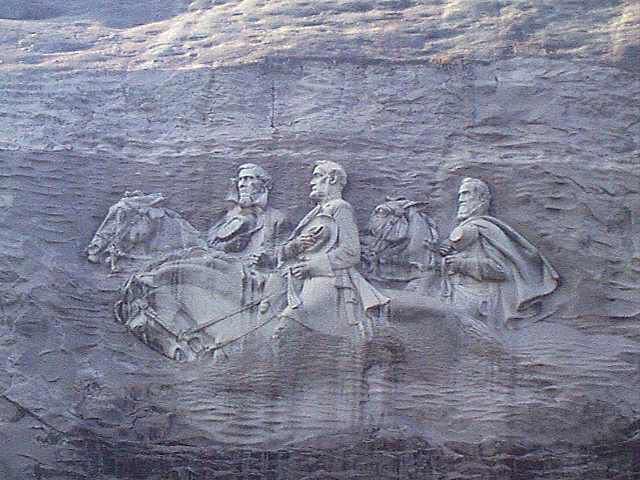
I am back from one of the best vacation experiences in a very long time. We began by flying to Denver from Orlando, a pleasant 2 1/2 hour journey. We then sojourned to Mount Rushmore in South Dakota. I've read and seen hundreds of pictures of this monument from early childhood but didn't realize how little I knew about the history and controversy surrounding it. Firstly, I discovered that it originally began as a tourist gimmick that was supposed to take 2 years to complete. But the sculptor, Gutzon Borglum, foresaw something bigger. Borglum had worked previously on the Stone Mountain sculpture of Lee, Davis, and Stonewall. Borglum foresaw a monument that would encompass the ideals of America and become a tribute to our republic and celebration to Democracy. I was surprised at the emotional impact the monument had on me and my family. My father just stood there and stared at it for a long time. I walked around the monument perimeter and walked around Borglum's studio. It was interesting seeing how he worked and how the sculpture was created. What was supposed to take 2 years, actually took 14. When we made it back to the Gift shop Bookstore, we met one of the original workers who drilled on the sculpture. He was a tough old cuss and reminded me of my grandfathers. He said that at first it was "just a job" but later he and his fellow workers began to see the work as a calling. They saw that they were helping to create something that would last longer than the Pyramids. Later in the day we went on to the "Crazy Horse" monument dedicated to the great American Indian leader, who was instrumental in defeating Col. Custer. What is interesting about this monument is that it was designed by a Polish American, Korczak Ziolkowski and is worked upon by his family. Although, the Native American leader, Lakota Chief Henry Standing Bear originally commissioned the sculpture, there are few Native American's actually involved in it's construction. Most of the money to carve the monument comes from donations of the largely white American visitors. I wondered while I was there, given the huge amount that the Seminole Tribe and other Indian gaming casino's have made, why don't they help? You would think they could spare a million or two. Perhaps they have given something, I don't know, but they weren't on the donor list that I could find. I couldn't help but wonder if the monument is really a White-man creation to White-man guilt?

The next day we crossed Wyoming and headed to Yellowstone. Yellowstone is the nation's and World's first national park. It is simply breathtaking in it's beauty and serene loveliness. We were only able to see about 10% of the entire park. However, we hit most of the highlights that you read about, such as "Old Faithful" and the many other natural hot springs. We arrived at the Old Faithful area, just as the geyser was about to erupt and got several great pictures. We toured around and saw about every animal you can imagine. Elk, deer, bear, moose, all kinds of birds, and plant-life you can conjure was there to enjoy. The park restaurants, lodges, and other facilities (even the auto-mechanic shop) had a real 1910-1920's look and feel to it. It was interesting that they continue to keep the old fashioned look. That made the park all the more enjoyable for the architecture. At any moment I expected to see Teddy Roosevelt turn the corner and waive. Later that day we visited a tourist trap gold mine and panned for gold (I didn't pay for my trip but it was a hoot playing the prospector. All I could think about was Bogey and the Treasure of the Sierra Madre). Later that next day we went to the Buffolo Bill (William F. Cody) museum. And saw the original stage-coaches, costumes, and even Annie Oakley's guns. There was so many posters and press clippings about him that you forget what a superstar Buffalo Bill was and how much of the American West he played a part in, from the rise of the rail-road to the Civil war to the end of the "wild" Indian Nations and the closing of a colorful part of American History.

My parents then went home the next day and we took a over night camping trip deep in the Shoshone National Forest Wilderness area (which connects to Yellowstone). We took horses about 10 miles into the park and camped by the river. It was wonderful to fly-fish with my sons and take in the natural beauty. This photo here is taken from my chair at our campsite. This was Cindy's first experience camping and she really enjoyed it. We then rode out and drove to Estes Park and Rocky Mountain National Forest for the rest of the time. I had been there with my Uncle Dwight in 1997 and it was just as beautiful as I remembered. We drove the car to the top of one of the highest peak that was actually above tree line and into Alpine Tundra area (about 11,764 feet above seal level). The boys got to play in the snow which is an unusual treat for Florida Boys. The air was so thin though that I got a little sick climbing up the remaining 300 feet of the mountain to the top. We finally made it down and ended our vacation to a trip to the US Mint in Denver for coins (as you can buy them direct from the mint with no mark up for Proof-sets and other collect able coins).

All in all, it was a great time and a rare look at the magnificent beauty and grandeur of our beloved nation.

Monday, March 31, 2008

SUB PRIME EDUCATION

The clamor is getting louder for the federal government to “fix” the sub-prime loan problem. Somehow an arm of the government is to order mortgage companies to extend the introductory rates. That such a solution is even discussed is an example of how poorly our populace is educated in economics.

A co-worker told me about a report on TV saying that minorities were sold a greater percentage of sub prime loans, proving that corporations are not only evil but racist. Sub prime loans were created in the first place because companies were coming under fire for not loaning to minorities. The lower introductory payments qualify more people and thus make the numbers look better.

The other result of these loan packages was that everyone could suddenly afford a bigger house up front. And since mortgage brokers and realtors make their commissions as a percentage of the contract price, the two most influential professionals in home sales were pushing their customers down that road. The up-front commission structure for salesmen created an incentive for big loans. The salesman isn’t responsible for the re-payment. No CEO said lets start making bad loans. It happened as a result of the reward structure.

The real culprit in the sub prime fiasco, the real villain is the Department of Education. We pay bureaucrats billions to create an education policy in this country and kids graduate high school without the vaguest idea of why sub-prime loans are risky. Why are we sending kids to school for 13 years on the dime of the tax payer and not teaching them about dimes?

The main reason is that schooling has become a form of social policy, trying to shape society through the minds of the young rather than teaching practicality. A secondary reason is that the education bureaucrats see the world in terms of the academic subjects that led them to Harvard and then to the cushy chair in Washington. Bureaucrats have the luxury of being bad with money because it is easier for them to make money. These kinds of people don’t understand the practical needs of Americans. They are occupied with trying to turn every youngster into a philosopher-king.

There are two chances in life for education, first formally when nothing is at stake but your own time and attention, and secondly in the school of life where decisions have real outcomes. For as much as people will be hurt by the sub prime reality, the lesson of pain will ensure that others wake up and pay attention to their own future economic decisions. It’s the only hope for a better future, because the Department of Education isn’t changing for anyone.

Saturday, February 16, 2008

RANDOM THOUGHTS

1. Thanks to the "Juntoboys" for inspiring me to continue my research on Prisoner Re-Entry. I am now writing a proposal with a collaborator I found at the University. We are putting together a research project to study some of the ideas I developed and test them for effectiveness. This is very exciting as this will likely turn into funded and publishable research.

2. I've been reading a lot lately about Neuropsychology (a new and growing field). Particularly I am currently reading research on The Neuropsychology behind Paranormal Experiences. This field was evidently pioneered by Michael A. Persinger, Ph.D. who also invented a crazy contraption called the "God Helmet." The God-Helmet introduces ultra low frequency pulses of Electro-Magnetic energy into the temporal lobes of the brain. This device is devised so that it will induce religious/paranormal experiences in those who wear it. Among reported experiences are the feeling that someone is watching you, feelings of oneness, feelings of being pulled from the inside, fear, anger, joy, and a variety of other emotions. Persinger believes that stimulation of the temporal lobes is what causes mystical experiences as well as Alien abduction reports. I've got the plans for this helmet and am currently building one for my own experiments.

3. I've been tasked with teaching more diversity courses now. Apparently my students love my "refreshing right wing approach" (as one student evaluation put it) to diversity areas such as Cross cultural psychology, Psych of Women, and Psych of Racism.

4. What if McCain asks Barak Obama to be his Vice-President, which was earlier suggested in this blog by "E" I believe. Would that collapse the ends of the Bell Curve (ultra right conservatives and ultra liberals) creating a new coalition of moderates, independents, and the like? Are we in for a major political transformation of the cultural landscape? All pundits seem aghast.

5. If social intelligence or emotional intelligence is a valid construct, then evidently there must be Emotional Genius'. If so, what would they look like? What would an Emotional Einstein be like? Would they be master manipulators able to inspire or corrupt or whisper and control at will? Sounds like a cool power. Perhaps that is what the great leaders and politicians were.

6. The recent book "Love and Sex with Robots" is quite fascinating. I've been waiting for the Robot Women and Flying cars all my life. This books central thesis is that as robots become more and more human like, we will eventually begin using them for intimate practices as well. It makes sense since the average Joe/Jane uses a computer and a variety of mechanical aids currently to enhance carnal pleasure. It would be nice in some ways because the Robot Woman would not nag, nor divorce, nor spend you into bankruptcy. It's all very interesting. I suppose the sophisticated enough Robot woman could be intellectually stimulating (since she would have a internet enabled brain and therefore access to the sum total of human knowledge) plus physically arousing since presumably some basic psychology tests could discern the exact physical type you would be interested in. Human women may be jealous at first or not allow this at all (just as many now rally against Porn and such) while others would view the Robot Woman as simply an appliance and would likely welcome this addition which could help "fill the void" between love making sessions and thus help curb her Human Husbands desire to cheat. Since the Robot Woman would be learning enabled and adaptive, she would continue to get better with each session and could create both variety as well as become a teacher to the human couple or even live-aid for the ultimate "threesomes."

Monday, December 24, 2007

RALPH EUBANKS RIP

No matter where I move UWF finds me. It shows how strong the fund raising motivation is. They publish a glossy magazine every quarter talking about what’s happening at the college. This time I learn that Ralph Eubanks passed away at the age of 86. Dude and I had Ralph for Communication Ethics and he was Professor Emeritus even then. He was a heck of a nice guy and he would talk with you for an hour about anything. He was the only professor to quote H.L. Mencken during my college years.

He was impossible to keep up with as an instructor. His talks were very stream of consciousness and the tests were fill-in-the-blank quizzes on those lectures. I guess he wanted you to transcribe his lecture and study that. I remember that Angela Hatcher came over to our dorm to study for the final, but we decided to simulate play the 1978 Yankees v. 1979 Pirates instead. Dude and I played a 50 game season with those two teams and I will never forget how fun it was, a lot more memorable than my grade in Ralph’s class. Hatcher was frustrated with us, Skinny Lynnie was frustrated with us, but Dude and I were in our element.

A year or so later we saw Dr. Eubanks on campus and I told them that were taking some sort of fiction class and decided to see the movies instead of reading the text. Ralph laughed and he said that there was no one has more ingenuity than a college student. Shortly after Dude’s first attempt at Atlas Shrugged he showed me a passage where they mention the character Balph Eubank, and we both laughed. I wonder if Ralph ever read the book.

It says that he died in Little Rock Arkansas. 86 is a good long life and Ralph was a happy man. Thanks, Ralph for being a part of our great memories.

Saturday, September 29, 2007

ACADEMIC FREEDOM DOES EXIST (so far)

Well, well, I'm into my first semester and given out my first set of exams. So far academic freedom does exist. We got a good talking to on Friday from the Chair of the department. He re-advowed his commitment to Academic Freedom. (He didn't expand onto why he was bringing up the subject, but I guess that some Prof. must have asked or felt insecure). He explained that Academic Freedom meant the professors have the right to teach their classes however they see fit and say anything in class; even "controversial" statements. Of course he didn't elaborate on what that meant. Mostly I've found "controversial" means that you simply say the most extreme left wing thing you can and wait for gasps. Unfortunately, the gasps seldom come anymore since everyone expects the left-wing thing to be said by any given prof. What I've found thus far from the professors point of view is that this is a whole lot of fun. It is great to educate a new generation on the subjects I hold dear. My Cross-Cultural class has turned out to be my favorite mostly because there is so much leeway to include politics in the class since most of the subject matter lends itself to political discourse. However, some of the students have caught on to my right leaning, libertarian stances. The more savvy students are waiting for a derogatory remark about the Dems or Clinton or such and then are leaping forward. I confronted one in class recently and made her prove her point. (I had made a rather neutral comment about Bill Clinton being long winded in his speeches---a valid point as Bill made the infamous 2 hour speech at the Dem Con many years ago). Before I could finish my point, she had lept and stated, "Well at least he can finish his sentences, at least he could speak in coherent thoughts, etc" I stopped and said, "Oh really? Could you give us an example? Whom do you refer?" on and on I went. I hated to exert my power thusly, since I had been similar to the student in my youth and could not always defend myself, but perhaps that is part of the whole learning process anyway. And secondly, that student is sort of nuts.

I haven't gotten fired yet and thus far the school has completely left me alone. No one has questioned my book selections (one book is a Heritage Foundation selection) and no one has questioned my methods...at least to my face. Most students seem to express gratitude (much as I did when I found the lone conservative professor) and ask what class will I be teaching next. On one sad note, I've been told through the grapevine that they are going to try and steer me away from "diversity" classes like Cross Cultural and instead give me more pure science classes like Perception/Learning and Abnormal Psych to teach. Maybe I'm not teaching the Cross-Cultural class the "right way." That is sad because it kind of goes against what the Chair had to say. I'm sure that if I confronted them I'd get denial and accalaids for my scientific mind that is sorely needed. Blah, blah. I've asked to teach the Psychology of Women next, THAT is one I'm REALLY looking forward to! But we'll see. More adventures in Academia to come...

Monday, September 24, 2007

COLUMBIA UNIVERSITY

Columbia University bans ROTC at their campus under the guise of the "don't ask don't tell policy." You'd think that Ahmadinejad would be disqualified simply for his views on that subject. But the elite have a certain fascination with any figure who is anti-American. They will forgive almost any specific position as long as the American right wing doesn't like him/her. It's always under the guise of having a dialogue.

Freedom of speech does not guarantee a bullhorn or a platform, just the protection that you won't be arrested. It doesn't make us a more noble country to allow our enemies such a demonstration. It just makes us look like dupes to other dictators.

The media quotes Bollinger's denunciation as if that makes him some kind of hero. A few days ago Bollinger spoke about the importance of dialogue and today he didn't even let the students confront the tyrant with impromptu questions. They were all screened and read officially just like back in the home country.

Why are tax dollars going to universities that oppose the military or give a platform to our enemies? This is not just a man who espouses anti-American positions, but someone who has been killing American soldiers in Iraq.

I'm not so much bothered by the theatre of today's event because it doesn't surprise me. But I am bothered by how higher education has taken on a sort of religious infallibility. Our job is to fire hose money at it and their job is to show us what rubes we are. There needs to be a better balance if we're to continue to foot the bill.

Monday, April 23, 2007

THE PROPHET OF DOOM!!

The Prophet is one who has special knowledge or wisdom that others are not privy to. The True Prophets of old were those who communicated directly with the Divine and then shared the knowledge with the village or kingdom of which they served. Usually a prophet of old warned others about pending issues but also gave a true and good way to avoid the problems. Joseph in the Bible is a good example. He was brought before the Egyptian Pharaoh at the time who warned Egypt that 7 years of famine was coming immediately following 7 years of plenty. The warning allowed Egypt to save up grain during the good years so they could survive the bad years. There were also "false Prophets." False Prophets were those who made Prophesies that were not from the Divine but were motivated from selfish reasons, usually for personal monetary gain.

Today our culture has divided this noble calling into two false prophet varieties: 1) The Prophet of Hope, and 2) The Prophet of DOOM. The Prophet of Hope offers us the vision of the shinning city on the hill, of what the best of us could be and of the bright future ahead. He is hoping you'll jump on his band wagon and ride it to party central. We do admire the Prophet of Hope. We smile and nod condescendingly at their optimism. We laugh and pat them on the back (all the while shaking our head inwardly and saying, "Poor naive Prophet of Hope"). Experience teaches us to expect the worst because when it doesn't happen, we can relax. We certainly aren't disappointed. A good example of the Prophet of Hope is Gene Roddenberry. We love Star Trek and wish/hope that this wonderful world will come true. But most of us smile and nod, knowing that it'll be more something like Blade Runner or Alien (where all the corporations run the future).

The Prophet of Doom on the other hand is listened to very carefully. He projects fear and always talks about the worst case scenario. We listen and ponder. His language is admired and fawned over. It is full of images of despair and misery. The smart Prophet of Doom is one who offers an escape (which is usually by following his advice and buying his book or video series or voting for him and his party or listening to his lecture, etc, etc.).

There is a curious reaction to the Prophet's. Hope we listen to but never forgive if he is wrong. He will be blasted and derided for the naive fool we knew he was. Another good example of the Prophet of Hope is Harry Dent who wrote, "The Roaring 2000's". He wrote this book at the end of the 90's during the stock market boom and predicted "The Dow will be in the 20,000's by 2010." Virtually none of Harry's predictions have borne out to be true. He certainly didn't even mention the incredible Real Estate boom. He gave real estate on paragraph and cautioned against investing in this "slow and lack luster" investment. Today you can buy his book new at a large discount on Amazon and buy it used on Amazon starting at 1 penny.

However, on occasion DOOM and HOPE meld and are borne out to be true (as was Reagan and his battle with the Commie's) he is seen as a great man, perhaps even "true Prophet" and is elevated to sainthood today. He warned of the cost of doing nothing (Doom) but promised of a shinning tomorrow (Hope). The halmarks of the true prophet. It takes great courage to be Hope or a Ture prophet. The true prophet is usually killed or destroyed because we can't stand to be in the presence of truth for long (espeically if we ourselves are living a lie and are invested in that lie).

Alternatively, Doom is always heralded as a genius when he is right but completely forgiven when he is wrong. It takes no courage to be a prophet of Doom. Doom is never front page news when he is wrong. We breathe a sigh of relief that Doom is wrong; glad in the knowledge that we have another day before the "world" ends. His incorrect books are filed away (but often still referenced because the smart Doom will leave his prophesies open ended with no exact date). Examples of Doom are the 17th and early 18th century over population experts.
In An Essay on the Principle of Population (first published in 1798), Thomas Malthus proposed that while resources tend to grow linearly, population grows exponentially. He argued that, if left unrestricted, human populations continue to grow until they would become too large to be supported by the food grown on available agricultural land, causing starvation which then controls population growth. He argued that this had happened many times previously in human history and estimated that this would occur again by the middle of the 19th century.
Of course by the technology of the day, that was certainly true. But who could have predicted the advances in chemical fertilizers, advanced machinery, complex food processing,
and other technology advances that have not only given the world the food it needs but it is actually at a surplus. The only reason for starvation in the world today is food distribution issues and dictators that want to oppress their people. All the current Enviornmental Guru's and Global Warming prophets are merely Doom prophets recylcing (pun intended) the old over population arguments of the 18th century.

You can see these two styles of Hope and Doom playing out in every endeavor of our culture. But particularly you see these two types happening in Religious organizations, Economics, as well as Politics. Our culture is one of anxiety. Anxiety that the communists or terrorists or criminals or Corporations or sinners or whoever is the bad guy of the day, is around every bush and only our willingness to fall before Doom and follow his teaching will save us. Doom offers no permanent solution (and if one is found then another bad guy or reason to fear is quickly invented). This is why Bush's numbers are so low. Bush is the Prophet of Hope while every Democrat rings the bell of Doom. With every new solider that dies, their Doom prophesies are seen as correct. Poor naive Bush, he was so hopeful but we all knew that was nonsense. No one looks at Northern Iraq that has never had a single American Solider death nor Southern Iraq, which is very peaceful. We focus on Baghdad.

When I was a kid, the tent revival evangelists would come into town. My parents took one out to dinner after a revival service one night. My Dad asked him, "Why do you preach on Hell all the time?" His answer was surprisingly refreshing, "Because I don't get as big an offering if I preach about only heaven." He had learned the rewards of the Prophet of Doom. People are motivated out of fear faster than from hope. They'll run to the literal or metaphorical Altar quicker from Doom than Hope. However, hope sustains in the long run, while Doom never sustains. Doom often becomes the self-fulfilling prophesy (i.e. The Branch Davidians and Jim Jones are good examples). Doom does not feed but quickly burns out. Eventually, we long and need hope. Truth sustains us through the dark nights and motivates us toward action. Doom builds weapons and fortresses. Hope and Truth build cities and civilizations and a brighter tomorrow.

Saturday, February 24, 2007

HOW TO GET GOOD TEACHERS

Micket Kaus has some common sense ideas about getting good teachers:

It's easier to hire good teachers if you can fire bad ones. Competent people want to work for competent organizations. Which offer would you be more likely to take: "Come work for our school district. We weed out the deadwood and we're doing a great job preparing our kids," Or "Come work for our district and spend your life beating your head against a bureaucratic wall."

Yes, teachers should be paid more--but it's weird that an idealistic liberal would think good candidates are only motivated by money. (And if you could fire bad and mediocre teachers then school districts wouldn't have to spend a big chunk of any pay raise boosting the salaries of ... bad and mediocre teachers).

Weed out bad old teachers and expand the pool of potential good new teachers by allowing certification of people who haven't met the mindless credential requirements fiercely defended by the unions.

I think Rush was the first one to say our education systenm is not about teaching kids but employing people. You often hear how tough it is to be a teacher. Being a student is even worse. You're stuck with whoever the machine sorts you into and your entire experience with a subject can be ruined with a half-assed instructor.

We have a lot of people that would make excellent teachers that wouldn't hassle themselves with the certification process and locked-in pay scales. What talented and ambitious person is going to join an organization where pay is determined simply by longevity? Lynnette would seem to an exception that rule, but her determination is working her into a lot of opportunities outside the classroom. I can't imagine her working for the school system in 5 years.

Thursday, January 18, 2007

A RESPONSE TO THE IQ QUESTION

The problem with the commentary from Charles Murray, is it makes the mistake that many make concerning IQ. IQ, as it is currently measured, is an measure of "intelligence" as defined by: your fund of knowledge, verbal fluency, processing speed, ability to see abstract concepts, and others. These domain areas are certainly not the only form of intelligence. Tom alluded to this fact when he stated that there were guys in our schools who were poor students but could take a part an engine. These are actually two forms of intelligence, academic and mechanical.

Dee Dickson said it best on her website when she quoted my personal favorite cognitive psychologist Dr. Howard Gardner

Dr. Howard Gardner, author of Frames of Mind and co-director of Project Zero at Harvard University, has created a Theory of Multiple Intelligences. He points out that school systems often focus on a narrow range of intelligence that involves primarily verbal/linguistic and logical/mathematical skills. While knowledge and skills in these areas are essential for surviving and thriving in the world, he suggests that there are at least six other kinds of intelligence that are important to fuller human development and that almost everyone has available to develop. They include, visual/spatial, bodily/kinesthetic, musical, interpersonal, naturalist and intrapersonal intelligence.

The strongest skills of many children lie in these six areas, which are frequently undervalued in some traditional schools. The fact is that when children have an opportunity to learn through their strengths, they may become more successful at learning all subjects--including the "basic skills."

Gardner believes that the eight intelligences he has identified are independent, in that they develop at different times and to different degrees in different individuals. They are, however, closely related, and many teachers and parents are finding that when an individual becomes more proficient in one area, the whole constellation of intelligence may be enhanced.

For this reason, we believe that it is important to encourage children to explore and exercise all of their intelligences. Creating a rich, nurturing, and stimulating environment filled with interesting materials, toys, games, and books lays the foundation for healthier, happier, brighter children! Students who have these kinds of experiences know many ways to learn almost anything!

Following are some characteristics of the different intelligences, along with ways to exercise and develop them:

Verbal/Linguistic Intelligence
Involves reading, writing, speaking, and conversing in one's own or foreign languages. It may be exercised through reading interesting books, playing word board or card games, listening to recordings, using various kinds of computer technology, and participating in conversation and discussions.
Logical/Mathematical Intelligence Involves number and computing skills, recognizing patterns and relationships, timeliness and order, and the ability to solve different kinds of problems through logic. It may be exercised through classifying and sequencing activities, playing number and logic games, and solving various kinds of puzzles.
Visual/Spatial Intelligence Involves visual perception of the environment, the ability to create and manipulate mental images, and the orientation of the body in space. It may be developed through experiences in the graphic and plastic arts, sharpening observation skills, solving mazes and other spatial tasks, and exercises in imagery and active imagination.
Bodily/Kinesthetic Intelligence Involves physical coordination and dexterity, using fine and gross motor skills, and expressing oneself or learning through physical activities. It may be exercised by playing with blocks and other construction materials, dancing, playing various active sports and games, participating in plays or make-believe, and using various kinds of manipulatives to solve problems or to learn.
Musical Intelligence Involves understanding and expressing oneself through music and rhythmic movements or dance, or composing, playing, or conducting music. It may be exercised by listening to a variety of recordings, engaging in rhythmic games and activities, and singing, dancing, or playing various instruments.
Interpersonal Intelligence Involves understanding how to communicate with and understand other people and how to work collaboratively. It may be exercised through cooperative games, group projects and discussions, multicultural books and materials, and dramatic activities or role-playing.
Intrapersonal Intelligence Involves understanding one's inner world of emotions and thoughts, and growing in the ability to control them and work with them consciously. It may be exercised through participating in independent projects, reading illuminating books, journal-writing, imaginative activities and games, and finding quiet places for reflection.
Naturalist Intelligence Involves understanding the natural world of plants and animals, noticing their characteristics, and categorizing them; it generally involves keen observation and the ability to classify other things as well. It may be exercised by exploring nature, making collections of objects, studying them, and grouping them.

So given that one accepts this as "true" then what is the value of "no child left behind" or other kinds of educational initiatives? Basically it goes back to social engineering. Politicians use the public school system to achieve their own agenda regarding their own beliefs. This is of course true for both sides. I don't believe anyone really cares about Johnny's ability to read. As long as he pays taxes.

I for one think "interpersonal intelligence" is the most important. I've seen this time and again. A very nice person, with limited academic intelligence, succeeds in the world simply because he understands intuitively how human systems work. In other words, he's charming. Charming people are enjoyable to be around. This is actually the form of intelligence we should teach more to our children but no one hears about these abilities. William Bennett attempted to discuss them in his "Book of Virtues" but it didn't quite hit this nail squarely on the head.

Further complicating the issues is learning styles. People learn in very different ways. Although traditional public schools have attempted to adapt to this phenomena in recent years by the implementation of "charter schools", mostly they simply teach the old fashioned way: rows of desks, books, teachers lecture. I for one am a auditory learner. I learn by listening and watching. Even though I can learn by reading a book, or writing, I still have to stop and visualize a concept in order to understand it. I was a poor high school student for this reason. But when I got into college, I did an experiment, I stopped taking notes in a semester of classes. I simply watched and listened to the class room instruction then read the text. I made A's that year. Other people must learn by doing or learn by watching alone or learn by reading only, or any combination of these and others I haven't mentioned.

Additionally, It's been my experience that people find their natural niche in any culture or subculture. My speciality intelligence is interpersonal, which is why I believe I naturally gravitated to a life in psychology. But what would a person like me have done 10,000 years ago when we were hunter-gatherers? Probably Shaman or tribal comedian. A psychologist wrote a book a few years ago (the title escapes me at present) about what shapes a child's personality. His studies concluded that peer influence and a child seeking a social ecological niche is what makes the personality. We all have our niche in the world. The key is knowing what it is and knowing how to profit from it. That is the true key to success and not leaving any child behind.

Wednesday, January 17, 2007

LEAVING SOME BEHIND

Charles Murray again writes what no one will want to hear:
Our ability to improve the academic accomplishment of students in the lower half of the distribution of intelligence is severely limited. It is a matter of ceilings. Suppose a girl in the 99th percentile of intelligence, corresponding to an IQ of 135, is getting a C in English. She is underachieving, and someone who sets out to raise her performance might be able to get a spectacular result. Now suppose the boy sitting behind her is getting a D, but his IQ is a bit below 100, at the 49th percentile.

We can hope to raise his grade. But teaching him more vocabulary words or drilling him on the parts of speech will not open up new vistas for him. It is not within his power to learn to follow an exposition written beyond a limited level of complexity, any more than it is within my power to follow a proof in the American Journal of Mathematics. In both cases, the problem is not that we have not been taught enough, but that we are not smart enough.

Now take the girl sitting across the aisle who is getting an F. She is at the 20th percentile of intelligence, which means she has an IQ of 88. If the grading is honest, it may not be possible to do more than give her an E for effort. Even if she is taught to read every bit as well as her intelligence permits, she still will be able to comprehend only simple written material. It is a good thing that she becomes functionally literate, and it will have an effect on the range of jobs she can hold. But still she will be confined to jobs that require minimal reading skills. She is just not smart enough to do more than that.

Having a low IQ doesn't mean you can't be a productive citizen. And if you think back to school days you can remember kids that just weren't cut out for book learning but they could rip apart an engine.

It's good for a society to value education but you don't have to go to college to be successful. Try hiring a handyman to fix some things around the house and you'll realize that he probably makes more than you if he's a hustler.

The problem with government education is that it won't be honest with itself about the limitations and expectations. Why not teach some kids vocational skills instead of trying to turn them into Voltaires?